


Long before emails, instant messages, and cheap international postage, writing a letter was not just an act of communication. It was an act of calculation. Every word carried weight, and every page had to be considered before it was filled. Let’s see why this mattered so much in everyday life at the time.
Staying connected in the Victorian era required patience, intention, and money. Letters were the primary way people communicated across distance, but they were not cheap. Paper itself cost money, and postal rates often increased with every additional sheet included in an envelope.
Still, people wrote. They wrote long letters, detailed letters, emotional letters. And when the page filled up but the message was not finished, they did something unusual. They turned the page sideways and kept writing across their own text. It was not elegant, but it was efficient.
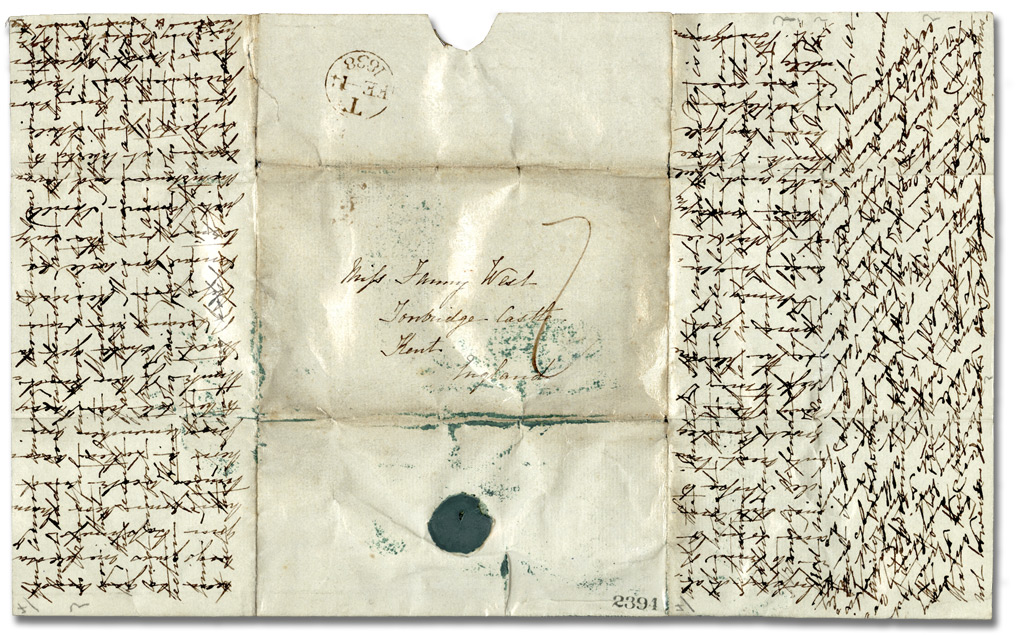
A crossed letter, 1837, Ontario, Canada. By F. L. Bridgeman – Wikipedia Images
The method became known as cross-writing, cross-hatching or crossed letters. A writer would first fill a page in the normal direction, then rotate it ninety degrees and write a second layer of text across the original text. To modern eyes, the result looks like a dense, overlapping puzzle of ink. But readers of the time learned how to navigate it.
At first glance, a crossed letter looks like an unreadable mesh of words. The trick is to focus on one direction at a time, allowing the other to fade into the background. Readers would follow one set of lines first, then mentally switch to the second. Some used a ruler or straight edge to isolate a single direction of text. Others relied on familiarity with the writer’s handwriting to separate the two directions.
Thin paper made the effect even more complex, as ink from the reverse side could show through and interfere with readability. In more extreme cases, letters were re-crossed: after completing the first pass, the writer would rotate the page again, sometimes at a forty-five-degree angle, and write over the text once more. This allowed an extraordinary compression of content, with several pages of writing fitting onto a single sheet.
Although the result may seem difficult to decipher at first, the human mind adapts quickly to patterns. Once familiar with the structure, cross-written letters prove surprisingly readable.
Not everyone approved. Lewis Carroll, for instance, strongly disliked the practice. In his essay Eight or Nine Wise Words about Letter-Writing, he advised writers to simply use another sheet of paper instead, warning that “cross-writing makes cross reading.”
Practical, yes. Pleasant, no.

Frances (Appleton) Longfellow to Emmeline (Austin) Wadsworth, 19 June 1839.
Despite criticism, cross-writing remained common throughout much of the 1800s, especially before postal reforms and cheaper mailing systems changed how people communicated. It appears often in surviving letters from the period and even in literature. In Jane Austen’s Emma, Miss Bates mentions a letter from Jane Fairfax that had “one side crossed,” a detail that contemporary readers would have immediately understood.
Today, cross-written letters feel almost like visual artifacts from another world. They capture a time when communication was slower, more expensive, and more deliberate. A time when even a page of paper was worth stretching as far as it could go.
Would you try it for fun? Take it as a challenge and send crossed letters to someone you love. Better than the ordinary WhatsApp messages.
P.S: The main image contains a letter from Caroline Weston to Deborah Weston, on a Friday, March 3, 1837.


