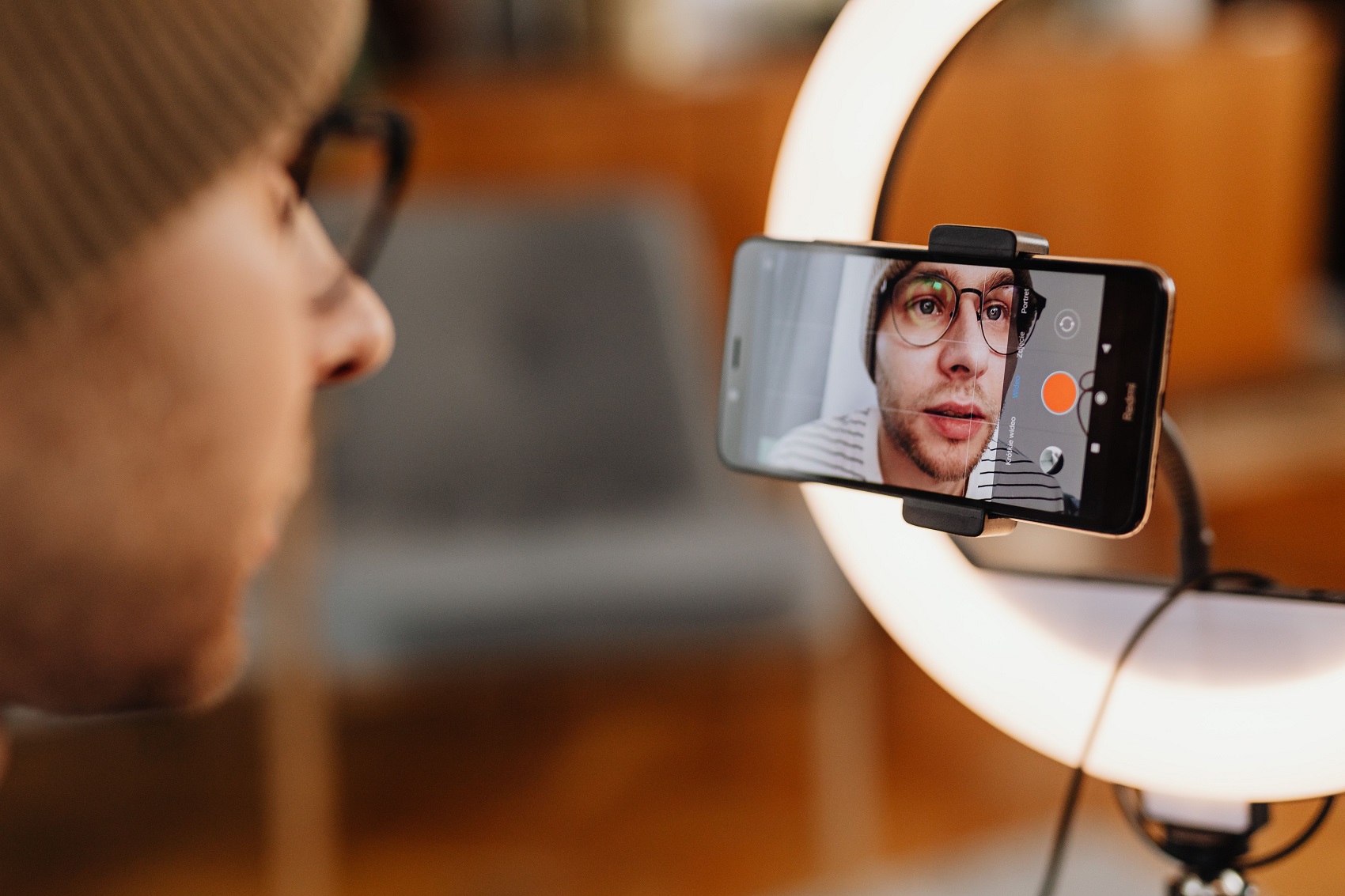


We used to meet our reflection in a mirror. Now, for many of us, we meet ourselves through a phone screen. The selfie has become one of the most ordinary gestures of modern life. A quick photo before going out, a story posted online, a new profile picture, a moment captured without much thought. Selfies are everywhere, shaping not only how we present ourselves to the world, but also how we perceive our own faces. There is something strange about them: the person we see in a selfie is not exactly the person other people see. And over time, that small difference can change the way we feel about ourselves.
The main change comes from distance. A selfie is taken extremely close to the face, and that proximity alters how depth is recorded. Features that sit closer to the lens take up more visual space, while those farther away shrink in relation. This shifts proportions without changing the face itself. This is why the nose can appear more dominant, while ears and jawlines seem reduced. It is not a change in appearance, but a change in spatial mapping.
The same principle appears in forced perspective photography, where objects seem to interact across impossible distances. The camera is not altering reality, but it is reshaping how that reality is projected.
On top of that, lenses introduce their own imperfections. Barrel distortion makes the center of the frame subtly expand outward, while pincushion distortion compresses it inward. These effects are not evenly distributed and tend to become more noticeable near the edges, where light enters at sharper angles. That is why features placed off-center can appear stretched or slightly unstable.
Then there is the digital layer. Phones do not simply capture an image anymore; they interpret it. Automatic processing can adjust brightness, smooth texture, enhance symmetry, and subtly reshape facial structure. These changes are not always obvious in isolation, but together they refine the face into a more idealized version. When this version becomes the most frequently seen, it slowly becomes the reference point.
There is also a psychological layer to this mismatch. A mirror shows a reversed version of the face, flipped left to right. That is the image most people grow up seeing every day, from childhood onward. Over time, the brain encodes that flipped version as familiar. A selfie, on the other hand, often removes that flip. What appears in the photo is closer to how other people see you, but it is not the version you are used to. This is why many people experience a subtle sense of unfamiliarity when looking at photos of themselves, even if others perceive them as normal.
It is not that one version is more accurate than the other. It is that familiarity plays a stronger role in recognition than geometric accuracy. The brain prioritizes what it has learned to recognize.

PH: Kampus
Another factor is repetition. The more often we see ourselves through selfies, front cameras, and filtered apps, the more those versions begin to accumulate in memory. This creates a gradual shift in internal reference. A slightly altered, processed version of the face becomes the one most frequently encountered. Over time, that version begins to compete with older mental images formed through mirrors and direct perception. When multiple versions of the same face do not fully align, the brain registers a subtle mismatch. Even when the difference is small, it can create a sense of unfamiliarity or quiet discomfort, without any actual physical change.
Faces are central to identity. The brain is highly specialized in recognizing and tracking facial features, which means even small distortions can influence emotional response and self-evaluation. Selfies are not neutral records. They are processed, filtered, and repeatedly viewed interpretations of the self. Over time, this creates a fragmented visual environment where multiple versions of the same face coexist across mirrors, cameras, and digital platforms. The mind tries to reconcile them into a single stable image, even though no single version is complete.
In the end, selfies are not just photographs. They are part of a broader shift in how self-perception is constructed. Instead of one consistent reflection, there are now multiple slightly different versions of the same face, shaped by angle, distance, light, and processing.
This leads to a persistent question: which version is the real one? And the answer is that none of them fully is. Each image captures a specific condition of the face, but none captures it entirely. The face has not changed. What has changed is the way it is being seen.