

Every painting has a story waiting to be discovered. The choices an artist makes, from color to line to composition, are never random. They reflect the artist’s life, their ideas, and the world they inhabit. Some details whisper subtle meanings, others demand attention, and many are hidden in plain sight. Understanding these choices allows you to step closer to the artist’s mind, to see beyond the surface and feel the intention behind every stroke.
Art is not only a visual experience but a conversation across time. By paying attention to how painters worked, the techniques they used, the symbols they embedded, and the emotions they captured, you can uncover layers of meaning that make each canvas richer, deeper, and more alive. These ten insights reveal the hidden brilliance of the artists’ decisions and show how seeing with awareness transforms the way you experience paintings.
Frida Kahlo’s work reflects her personal experiences, particularly the injuries she sustained in a bus accident that affected her mobility for the rest of her life. Confined to bed for long periods, she used a mirror on the ceiling to paint herself. Her body became both the subject and the lens through which she expressed her reality. In The Broken Column, her spine is depicted as a fractured Ionic pillar, with nails embedded in her skin. Each painting records her physical and emotional state, showing how she transformed her experiences into visual expression and self-exploration.

Frida Kahlo, The Broken Column, 1944. PH: Erich Lessing Culture and Fine Art
Caravaggio brought a striking realism to his paintings that surprised audiences of his time. Rather than using idealized models, he depicted people he observed in taverns and marketplaces. Prostitutes, thieves, and beggars became saints and apostles in his work. The textures of skin, the details of everyday life, and the contrasts of light added intensity and immediacy to his scenes. His approach revealed that the extraordinary could emerge from the ordinary, giving divine stories a grounded, human presence.
Claude Monet’s later paintings were influenced by his struggle with cataracts, which changed how he perceived color. The bright blues and violets of his early Water Lilies shifted toward deeper reds and browns. After undergoing surgery, Monet was able to see ultraviolet light, a part of the spectrum that most people cannot perceive. These changes affected his choice of colors and contributed to the evolution of his style, bringing some of his work closer to abstraction while reflecting the impact of his vision on his artistic process.
Scientific analysis of The Starry Night has revealed that Vincent van Gogh’s swirling skies closely resemble mathematical patterns found in turbulence. The movement in the painting reflects how energy flows through fluids, clouds, and other natural systems. Van Gogh arrived at these forms intuitively, without formal scientific knowledge. His heightened sensitivity allowed him to translate motion and intensity onto the canvas, capturing patterns that also exist in the physical world. The result is a painting that connects emotional expression with observable natural phenomena.

In the last decade of his life, Henri Matisse transformed white paper and gouache into vibrant compositions of plants, animals, figures, and abstract shapes. Using scissors as his main tool, he arranged pieces pinned to boards or walls, often with the help of studio assistants, before mounting them permanently.
Diagnosed with cancer in 1941 and reliant on a wheelchair, Matisse lost much of his physical strength but found renewed creative energy. His cut-outs demonstrate that artistic vision and expression can flourish despite physical limitations.
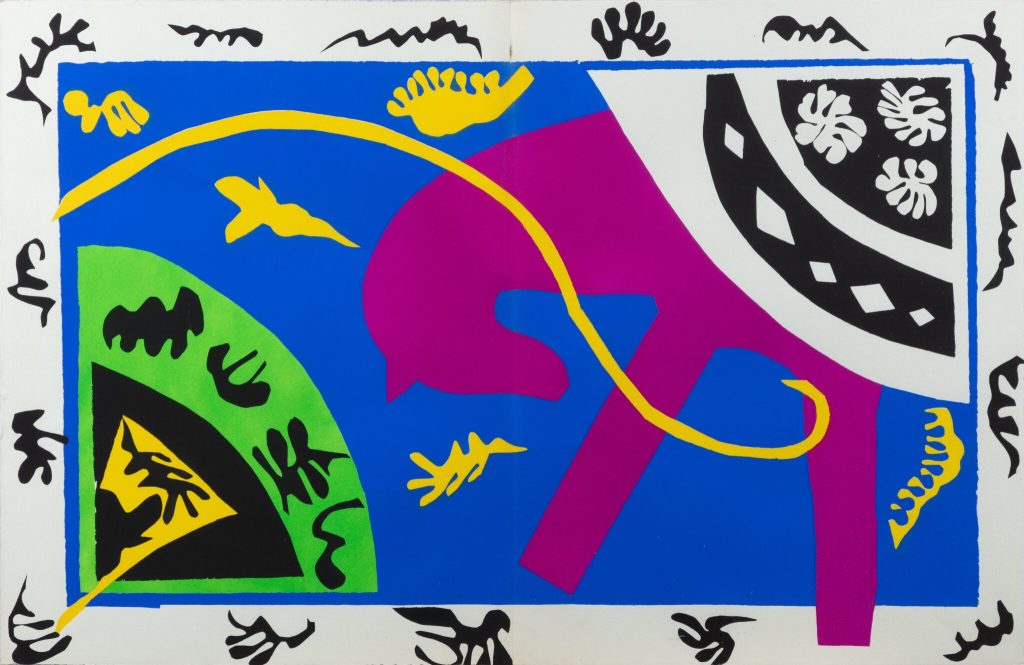
Henri Matisse: How a Scissors Transformed Limits into Creative Freedom – Jazz.Paris.Teriade 1947 – The horse, the rider and the clown
Edgar Degas valued direct observation more than imagination, and his fascination with movement pushed him toward emerging technology. He used photography to study dancers and horses, analyzing anatomy and motion in ways the naked eye could not fully capture. The unexpected cropping and tilted viewpoints in his paintings reflect photographic composition at a time when photography was not yet widely accepted as art. By integrating the camera into his practice, Degas anticipated shifts that would later shape modern painting and visual culture.

By Edgar Degas – Metropolitan Museum of Art, Public Domain
Michelangelo’s fascination with the human body went far beyond surface form. While living in Florence, he studied anatomy by secretly dissecting cadavers, gaining first hand knowledge that few artists of his time possessed. This deep understanding later surfaced symbolically in his work. In The Creation of Adam, scholars and neurosurgeons have identified the clear outline of a human brain formed by the shape of God and the surrounding angels. The structure closely matches anatomical accuracy, suggesting intentional design rather than coincidence. Through this visual layering, Michelangelo appears to link divine creation with human intellect, turning the fresco into both a spiritual statement and a quiet scientific revelation.
The quiet luminosity in Johannes Vermeer’s paintings has intrigued viewers and historians for generations. The clarity of his interiors and the gentle transitions of light have led many scholars to suggest that he worked with a camera obscura, an early optical device that projected an image onto a surface. Such a tool would have allowed Vermeer to study light with exceptional precision, including soft focus effects and subtle shifts in clarity that resemble photographic vision. Rather than undermining his artistry, this possibility reveals a painter deeply engaged with observation, perception, and emerging technology. Vermeer’s work suggests that technical curiosity and artistic sensitivity can work together in the creation of lasting beauty.
In the 1880s, Georges Seurat approached painting with the mindset of a researcher rather than a romantic. Influenced by chemist Michel Eugène Chevreul’s theories on color contrast, he applied tiny dots of pure pigment instead of blended brushstrokes, relying on the viewer’s eye to complete the image. This method, later known as pointillism, turned perception itself into part of the artwork. A Sunday Afternoon on the Island of La Grande Jatte was constructed through careful calculation, testing how color relationships could produce balance and visual harmony. More than a century later, photographer Mark Preuschl recreated the scene using real people, showing that Seurat’s exploration of color, optics, and human perception continues to resonate well beyond his time.
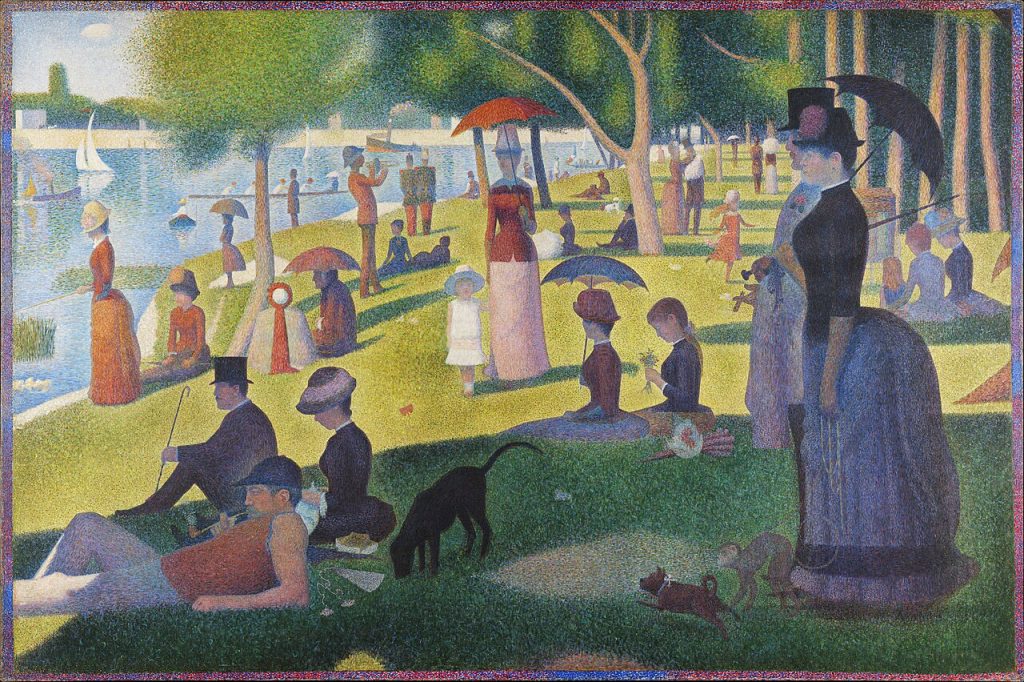
A Sunday on La Grande Jatte, Georges Seurat, 1884. PH: Wikipedia
Salvador Dalí drew directly from his inner world, transforming fears, obsessions, and dream imagery into some of the most recognizable works of Surrealism. Influenced by Sigmund Freud’s writings on the subconscious, Dalí treated dreams as a legitimate source of knowledge. Distorted bodies, melting forms, and unsettling symbols became visual translations of psychological states rather than decorative fantasy.
For Dalí, the subconscious was not something to suppress or soften. It was a place to observe, study, and confront. His work suggests that creativity deepens when artists engage honestly with their inner darkness, proving that imagination and emotion are inseparable forces in the making of enduring art.